Showing posts with label Epiphany. Show all posts

Tuesday, March 27, 2018

still on my mind... Can anything good come out of Nazareth?


Back in January - though it feels much more recent to me - a question was asked and a few remarks made that sparked international discussion. 

Here is one high-profile response:


In the midst of this, I read the lessons for the upcoming Sunday morning, on which I was scheduled to do supply (that is, preach and celebrate the Eucharist as a substitute for the regular priest) at a parish in the area. Apparently I am not the only one who wondered whether the president had read the lectionary in advance just to be sure he was speaking to the gospel reading at hand. 

It's still on my mind, now in Holy Week, during which we see that the Romans had a similar attitude towards the countries they were occupying and the citizens thereof. One need only consider that crucifixion was not a permitted form of death penalty for Roman citizens.  

Although I generally hesitate to share my sermons, I will share this one, as old as the topic may now be by general standards.  It's been pushed to the back burner because of more death in the news - too much death - but it seems to me that any form of attitude that makes someone "less than" is ultimately death dealing. Something to consider as Lent draws to a close, especially this week.
------

Epiphany 2B: What good can come out of Nazareth?
sermon for 1-14-18 

1 Samuel 3:1-10  (11-20) – call of Samuel
1 Corinthians 6:12-20 – glorify God with/in your body
John 1:43-51 – call of Philip, Nathanael under the fig tree
Psalm 139:1-5, 12-17

In the name of the Father, and of the Son, and of the Holy Spirit. Amen.

It’s good to be back - to begin to get to know you and to feel comfortable here. I appreciate your welcome, and I look forward to talking with you at coffee hour following the service.

Meeting and getting to know each other can be both a delight and a challenge. Imagine for a moment that you’re being introduced to someone. In the United States, one of the first things people ask is “what do you do?” That has its issues – but that’s for another day. Another question we hear is “Where are you from?” Now, the question “Where are you from” has the potential to capture so much meaning, depending on how it is answered and explored. A resulting conversation could show so much of who we are in so very many directions. Such a question and response provides a window into the other person. Where we’re from is very personal. Think of the related expression, “She knows where I’m coming from.”. It’s a feeling of being understood.

But we don’t always go there. “Where are you from?” and other such introductory questions can give us the sense that we know all about someone when in fact we have very little idea. Hearing that someone is from Fort Wayne, Indiana, or from Manhattan could lead you to very different ideas – which could be far from accurate. But you know those New Yorkers… Yankees fans, the lot of them.

Too often we think we know where someone is from, box them in, and fit them into our schema of The Way Things Are, and that’s that. Even putting people in what we think are GOOD boxes can be problematic because then we aren’t seeing or hearing the actual person, but only what we expect.

Jesus had this problem. He might have been born in Bethlehem and been a toddler in Egypt, but he grew up in Nazareth in Galilee, a poor town in a poor region. On the night he was arrested, Peter was identified as one of his disciples by his accent alone.

Jesus got it from home, too. When he preached in his hometown synagogue, people got offended. As they put it,
“Is not this the carpenter’s son? Is not his mother called Mary? And are not his brothers James and Joseph and Simon and Judas? And are not all his sisters with us? Where then did this man get all this?’ (Matthew 13:55-56)

Which is to say, “Who do you think you are?” We know where you’re from, so we know who you are, and we’ll judge you accordingly.

Now, really, generalizations are one of the ways the brain makes sense of vast quantities of information. It is when we regard them as hard and fast definitions that we run into trouble.  It’s when we decide we know enough about people to determine who they are – and we stop listening.

And that’s one of the issues we run into in today’s Gospel.

Listen again:
Philip found Nathanael and said to him, “We have found him about whom Moses in the law and also the prophets wrote, Jesus son of Joseph from Nazareth.” Nathanael said to him, “Can anything good come out of Nazareth?” Philip said to him, “Come and see.”

Can anything good come out of Nazareth?
Does that sound… eerily familiar to anyone this morning?
Apparently derogatory remarks about poverty-stricken areas and the people who come from them are nothing new. Hearing it from the White House, now, that’s something else again. Worse than the profanity, to me, was the press secretary’s follow-up, which reminds me of Nathanael’s initial attitude. He spoke of (and I quote) “permanent solutions that make our country stronger by welcoming those who can contribute to our society, grow our economy and assimilate into our great nation.” Which, as the New Yorker pointed out, suggested “that immigrants from places like El Salvador, Haiti, Liberia, and Sierra Leone couldn’t become productive and assimilated American citizens,” which is more than a little racist.[i]

Can anything good come from Nazareth?

In the Jesuit America Magazine, Fr James Martin explains, “Nazareth was a minuscule town of 200 to 400 people, where people lived in small stone houses, and, archaeologists say, where garbage, and excrement, was dumped in the alleyways…in other words, came from a …….. place [such as that][ii]  Elsewhere in the magazine I read, “Crumbling infrastructure, inadequate health care and crippling poverty do not make a life any less valuable.”[iii] True in Jesus’ time. True now. Pragmatically speaking, these things also do not make people less likely to work hard and contribute.

All this turmoil, mind you, was happening on the day before the anniversary of the earthquake in Haiti. Furthermore, Martin Luther King Day is tomorrow. And if nothing else, the events of this past year show you that racism is still one of the biggest problems we have in this country, and we don’t seem to want to deal with it.

But we don’t need to be racist to consider this issue. Can anything good come out of Nazareth/Haiti/Africa/the Midwest/the South/California//the Middle East …. the other political party? It’s not always demonization. It can even feel perfectly affable. We just KNOW who that person is. So we don’t listen. We can’t see. We don’t try because our minds are made up.

But sometimes we know we have limited vision, and we’re more like Nathanael. “Come and see,” said Philip. And Nathanael did. With a mind sufficiently open to change. What he thought he knew was wrong and he, being without guile/deceit, didn’t hesitate to say so. And thoroughly! “Rabbi, you are the Son of God!” he exclaimed. “You are the King of Israel!”

I want you to notice something here.  What made him change his mind is that HE had been seen and known and understood when he hadn’t even noticed Jesus nearby.
“When Jesus saw Nathanael coming toward him, he said of him, “Here is truly an Israelite in whom there is no deceit!” Nathanael asked him, “Where did you get to know me?” Jesus answered, “I saw you under the fig tree before Philip called you.”
Being seen and known and understood can be life-changing.

Jesus may even have heard his remark about Nazareth – but it didn’t matter. He didn’t dismiss Nathanael as an ignorant so-and-so. He didn’t even wait to be introduced. And this is wonderful.

God doesn’t wait to be noticed. YHWH comes to Samuel before Samuel knows him. In Psalm 139, the poet sings, “You have searched me out and known me… when I was still in my mother’s womb…”
 God knows us already – understands us – calls us by name.

The good news is that we, too, are capable of responding to the invitation to come and see. We can also extend the invitation like Philip. We can work to see, hear, and understand others without waiting for them to do the same, refusing to dismiss people as incorrigible. God did it for us, being born among seemingly incorrigible humanity and in a poor, hick town to boot. We can work for those who are constantly facing this kind of dismissal – or worse – on a day to day basis.

And we, like Samuel, can learn to pray, over and over, “Speak, Lord, for your servant is listening.”

“Where are you from?” we ask.
It’s still a good question. Just depends on what we do with it.


[i] John Cassidy, “A Racist in the Oval Office,” The New Yorker, January 12, 2018   https://www.newyorker.com/news/our-columnists/trump-shithole-comment-racist-in-the-oval-office
[ii] James Martin SJ, “Father James Martin: Why we should welcome people from countries Trump just insulted,” America Magazine, https://www.americamagazine.org/politics-society/2018/01/12/father-james-martin-why-we-should-welcome-people-countries-trump-just

Thursday, February 2, 2017

Feast of the Presentation of our Lord Jesus Christ in the Temple


Today we celebrate the Feast of the Presentation, a day in which we hear about Mary and Joseph bringing the baby Jesus to the Temple as required for first-born sons by the law. They came with two pigeons to sacrifice - not much, but what was required for those without means. What a surprise it must have been to have the elderly Simeon and prophet Anna praise God and speak of the child to the people around as well as to them!  I would love to meet Anna, especially, and hear the story from her perspective.
On this feast day at the convent, we celebrate the profession anniversary of one of our sisters, which adds another special note.

And, lucky me, I got to celebrate - which also means I got to wear my favorite chasuble with the amazing embroidery.


I found a blessing and dismissal for this feast on the Church of England at  http://www.oremus.org/ (marvellous site worth your support). They are not from their Book of Common Prayer (1662 version, still in use!) or from Common Worship (their modern language version).  I think The Promise of His Glory must be a sort of Enriching Our Worship, English style, though far more traditional. Fortunately, this blessings and dismissal lend themselves well to being sung, as we prefer to do on feast days.


THE DISMISSAL

9The president may say THIS BLESSING.
Christ the Son of God, born of Mary,
fill you with his grace to trust his promises
and obey his will;
and the blessing of God almighty,
the Father, the Son and the Holy Spirit,
be upon you and remain with you always. Amen. [8]
10
MinisterGo in the light and peace of Christ.
Thanks be to God.

You can find this and the rest of their liturgy here as well, including a couple of post-communion prayer options.

I also found a nice solemn blessing from Common Worship on the C of E website, but it might have required my passing out a copy to everyone so they could come in properly with the Amens. (Yes, the sung tone really does cue you, but early in the morning, extra help is always nice.) 


It's on the very last page of this pdf document.

one last view of the baby Jesus for this liturgical year

Where's the baby Jesus? I swear he was here just a moment ago...

With or without liturgy, we rejoice with Simeon and Anna and Jesus' parents today as we remember that moment and seek to incorporate it into our own lives.

May the One who was presented in the Temple be so welcomed into the heart of each one of us.

Saturday, December 17, 2016

Bethlehemian Rhapsody


Is this the real birth?
Is this Nativity?
Caught in a census
in the town of his ancestry.
Open your eyes
look up to the skies and seeeeeeee
He's just a poor boy
foretold by prophecy.
Because the wise men come, wise men go,
Angels high, shepherds low...

If you, too, want to sing along, there is also a version with lyrics available.


It's a wondrous story to me, to me...

Wednesday, January 6, 2016

a camel's epiphany

Found something wonderful. Must share.  It's from a literature blog by Dr. Robin Bates. In this post, he shares a poem of his father's, written from the point of view of one of the magi's camels. He introduces it with a reflection, part of which I'm sharing here (follow the link at the bottom to read the rest).

"I like it here
I’m staying with them
As I wanted to stay
In Bethlehem"
camel from St. John's, Hingham

Regardless of where we live and what we do, we can live in love and service.  That, the camel tells us, is how Christ’s love manifests itself in the world. 

There is an implied criticism in the poem of the kings for not having stuck it out with the Christ child–that’s why the camel has to slip away–so perhaps the poem does echo Eliot’s.  We once were in touch with divinity before returning to our normal lives.   Then again, as I said, we all of us lose the vision and must rediscover it.  Again and again. You’ll probably recognize the Biblical allusion in the final stanza but, in case you don’t, it’s Jesus’ assertion (Matthew 19:24) that “it is easier for a camel to pass through the eye of a needle than for a rich man to enter the kingdom of Heaven.” “Effendi” is Arabic for “Master.”


Fable of the Third Christmas Camel
By Scott Bates
(Editor’s note: The following poetic fragment, evidently an overlooked scrap of the Dead Sea Scrolls, was recently discovered near Jerusalem, stuck to the bottom of an empty bagel can. We offer here an approximate translation into modern English of this invaluable historical document.)
I went all the way
But on the return trip
I gave the caravan
The slip
One desert night
Quit Balthazar
With all his frankincense
And myrrh
And headed out
Across the sand
It was dawn when I came
To this strange land
And found this family
Living here
Without a camel
Because they were poor
So I stayed with them
Carried their hides
Gave all the kids
Free camel rides
Sat with the baby
Worked with the man
Sang them ballads
Of Ispahan
Carried the water
Pulled the plow
Loved my neighbor
Who was a cow
I like it here
I’m staying with them
As I wanted to stay
In Bethlehem
With that other
Family I knew
Which proves Effendi
That passing through
The eye of a needle
Is an easier thing
For a camel
Than a king
Epiphany from a Camel's Point of View


three kings - music for the Epiphany


Saturday, January 11, 2014

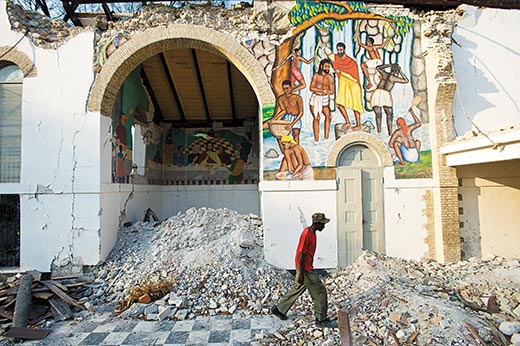
John baptizing Jesus amid the rubble


Tomorrow, the first Sunday after the Epiphany, we celebrate the Baptism of our Lord.  Tomorrow is also the fourth anniversary of the earthquake in Haiti.   When I realized that, I thought immediately of this cathedral mural, one of the few left after the earthquake, and the photos of it still standing, surrounded by rubble.  Jesus standing in the river, John pouring water over his head, while the people around go about their business.

As indeed we still do.  La vie continue...

Here in the US and also in Haiti, despite it all.  But here, we forget - both the baptism and the earthquake.  There, no one forgets. It's all around.

The Baptism of Our Lord - Cathedrale Sainte Trinite, Port-au-Prince (pre-earthquake) - Castera Bazile
http://www.diocesewnc.org/dfc/newsdetail_2/3162984

In my mind's eye, I can see the river flowing on from the scene of Jesus' baptism, out of the painting and through the rubble, a river of life that not even devastation of this magnitude can stop.  I can see the water of life flowing over Port-au-Prince, flowing over the surrounding area and, indeed, the whole of Haiti.

the Baptism of Christ by John in the Jordan by Castera Bazile 
http://southfloridaclassicalreview.com/wp-content/uploads/2011/04/Haiti-murals-at-Holy-Trinity-Cathedral-5.jpg

Lord, you are the one who heals and who quenches our thirst.  Continue to bring new life to Haiti. Along with restoration, let justice and peace spring up from that beloved earth. Comfort those who grieve or who are reliving those twelve seconds.  Wash away their terror and replace it with an awareness of your presence and love. Wash through us, too, healing, reviving, making whole.  Give us the compassion and wisdom we need in order to care for each other.  All this we ask in your dear name.

*  *  *  *  *  *  *

For those of you interested in more on this mural, this is what it used to look like:


Many of you know Holy Trinity Cathedral here in Port au Prince very well, and know the only earthquake survivor of the fourteen famous murals created by the leading artists of the day… the other thirteen were destroyed on that terrible day.  That mural depicts the Baptism of Christ by John in the Jordan by Castera Bazile.  It’s currently being restored by the Smithsonian.  I remember children looking up at it, learning the Gospel story in pictures.  It is part of the only remaining wall of our cathedral here. In that mural, Jesus and John are standing in familiar positions, John pouring water over Jesus’ head, a dove is descending from a tree which shades them.  But Jesus and John have Haitian faces, and so do the women upstream and downstream who are going about the business of washing their clothes in the river.  And it is not just any river, but a it’s waterfall resembling a pilgrimage site called Saut d’eau  in the central plateau, a scene familiar to most Haitians.  

In all fourteen murals of the life of Christ, the participants were Haitian, and the scenes were familiar village events.  There was no scene even slightly removed from Haiti’s everyday reality.  At the Marriage Feast in Cana by Wilson Bigaud, a Carnival band played for the bride and groom.  On the Road to Golgotha, by Prefete Dufaut, [he’s famous for painting the winding road to Jacmel on the south coast], but in that mural people rode burros and walked to market, were part of funeral processions, chatted with friends along the way, and set up stands for selling fruit as Christ passed by with the cross, part of the scene.  Jesus was not distant in time and space, but firmly in the here and now.  No separation. No lines.

That was an excerpt of a sermon I listened to last spring in Port-au-Prince at the Haiti Connection. To read the rest: http://www.haitiepiscopalconnection.org/sermon.html

Monday, January 6, 2014

nations will stream to your light

Arise, shine; for your light has come,
and the glory of the LORD has risen upon you.
For darkness shall cover the earth,
and thick darkness the peoples;
but the LORD will arise upon you,
and his glory will appear over you.
Nations shall come to your light,
and kings to the brightness of your dawn.
Lift up your eyes and look around;
they all gather together, they come to you;
your sons shall come from far away,
and your daughters shall be carried on their nurses' arms.
Then you shall see and be radiant;
your heart shall thrill and rejoice,
because the abundance of the sea shall be brought to you,
the wealth of the nations shall come to you.
A multitude of camels shall cover you,
the young camels of Midian and Ephah;
all those from Sheba shall come.
They shall bring gold and frankincense,
and shall proclaim the praise of the LORD.
- Isaiah 60:1-6


O God, by the leading of a star you manifested your only Son to the peoples of the earth: Lead us, who know you now by faith, to your presence, where we may see your glory face to face; through Jesus Christ our Lord, who lives and reigns with you and the Holy Spirit, one God, now and for ever. Amen. 
- Collect for the Epiphany - BCP p. 214

Monday, August 6, 2012

Transfiguration


Transfiguration
Luke 9:28-36
(art via Pax Christi Michigan)

Suddenly they saw him the way he was,

the way he really was all the time,

although they had never seen it before,

the glory which blinds the everyday eye

and so becomes invisible. This is how

he was, radiant, brilliant, carrying joy

like a flaming sun in his hands.

This is the way he was -- is -- from the beginning,

and we cannot bear it. So he manned himself,

came manifest to us; and there on the mountain

they saw him, really saw him, saw his light.

We all know that if we really see him we die.

But isn't that what is required of us?

Then, perhaps, we will see each other, too.

-- Madeleine L'Engle, Glimpses of Grace (San Francisco: Harper-Collins, 1996), 64.


Luke 9:28-36

28 Environ huit jours après qu'il eut dit ces paroles, Jésus prit avec lui Pierre, Jean et Jacques, et il monta sur la montagne pour prier. 29 Pendant qu'il priait, l'aspect de son visage changea, et son vêtement devint d'une éclatante blancheur. 30 Et voici, deux hommes s'entretenaient avec lui: c'étaient Moïse et Elie, 31 qui, apparaissant dans la gloire, parlaient de son départ qu'il allait accomplir à Jérusalem. 32 Pierre et ses compagnons étaient appesantis par le sommeil; mais, s'étant tenus éveillés, ils virent la gloire de Jésus et les deux hommes qui étaient avec lui. 33 Au moment où ces hommes se séparaient de Jésus, Pierre lui dit: Maître, il est bon que nous soyons ici; dressons trois tentes, une pour toi, une pour Moïse, et une pour Elie. Il ne savait ce qu'il disait. 34 Comme il parlait ainsi, une nuée vint les couvrir; et les disciples furent saisis de frayeur en les voyant entrer dans la nuée. 35 Et de la nuée sortit une voix, qui dit: Celui-ci est mon Fils élu: écoutez-le! 36 Quand la voix se fit entendre, Jésus se trouva seul. Les disciples gardèrent le silence, et ils ne racontèrent à personne, en ce temps-là, rien de ce qu'ils avaient vu.

9:28 ¶ Wit jou konsa, apre li te fin di pawòl sa yo, Jezi pran Pyè, Jan ak Jak. Li moute sou yon mòn pou li al lapriyè.  29 Antan li t'ap lapriyè, figi l' pran chanje, rad li vin klere tou blan.  30 Te gen dezòm ki t'ap pale ak Jezi: se te Moyiz ak Eli,  31 ki te parèt nan mitan yon bèl limyè ki soti nan syel la. Yo t'ap pale avèk li sou jan li tapral mouri lavil Jerizalèm pou l' te ka akonpli misyon li.  32 Yon bon dòmi te gen tan vòlè Pyè ak kanmarad li yo. Men, lè yo leve, yo wè bèl limyè ki te vlope Jezi ansanm ak de mesye ki te bò kote l' yo.  33 Antan mesye yo tapral kite Jezi Pyè di li: Mèt, sa te bon nèt pou nou te la. Ann moute twa ti kay, yonn pou ou, yonn pou Moyiz ak yonn pou Eli. Li pa t' konnen sa l' t'ap di.  34 Pandan li t'ap pale konsa, yon nwaj vin kouvri yo ak lonbraj li. Lè disip yo wè nwaj la ap vin sou yo, yo te pè.  35 Lè sa a, yo tande yon vwa ki soti nan nwaj la ki di: Moun sa a se pitit mwen, moun mwen chwazi a. Koute li!  36 Apre vwa a fin pale, Jezi te pou kont li ankò. Disip yo te fèmen bouch yo sou sa. Lè sa a, yo pa t' rakonte pesonn sa yo te wè.

  28 Now about eight days after these sayings Jesus took with him Peter and John and James, and went up on the mountain to pray. 29 And while he was praying, the appearance of his face changed, and his clothes became dazzling white. 30 Suddenly they saw two men, Moses and Elijah, talking to him. 31 They appeared in glory and were speaking of his departure, which he was about to accomplish at Jerusalem. 32 Now Peter and his companions were weighed down with sleep; but since they had stayed awake, they saw his glory and the two men who stood with him. 33 Just as they were leaving him, Peter said to Jesus, "Master, it is good for us to be here; let us make three dwellings, one for you, one for Moses, and one for Elijah"—not knowing what he said. 34 While he was saying this, a cloud came and overshadowed them; and they were terrified as they entered the cloud. 35 Then from the cloud came a voice that said, "This is my Son, my Chosen; listen to him!" 36 When the voice had spoken, Jesus was found alone. And they kept silent and in those days told no one any of the things they had seen.

28 Y como ocho días después de estas palabras, Jesús tomó consigo a Pedro, a Juan y a Jacobo , y subió al monte a orar. 29 Mientras oraba, la apariencia de su rostro se hizo otra, y su ropa se hizo blanca y resplandeciente. 30 Y he aquí, dos hombres hablaban con El, los cuales eran Moisés y Elías, 31 quienes apareciendo en gloria, hablaban de la partida de Jesús, que El estaba a punto de cumplir en Jerusalén. 32 Pedro y sus compañeros habían sido vencidos por el sueño, pero cuando estuvieron bien despiertos, vieron la gloria de Jesús y a los dos varones que estaban con El. 33 Y sucedió que al retirarse ellos de El, Pedro dijo a Jesús: Maestro, bueno es estarnos aquí; hagamos tres enramadas, una para ti, otra para Moisés y otra para Elías; no sabiendo lo que decía. 34 Entonces, mientras él decía esto, se formó una nube que los cubrió; y tuvieron temor al entrar en la nube. 35 Y una voz salió de la nube, que decía: Este es mi Hijo, mi Escogido ; a El oíd. 36 Cuando la voz se oyó, Jesús fue hallado solo. Ellos se lo callaron, y por aquellos días no contaron a nadie nada de lo que habían visto.

Tuesday, February 21, 2012

Shout it out now one last time!

one last alleluia before Lent begins!

Make it whole-hearted and joyful.

Monday, December 26, 2011

I hope they remember


I've just read a wonderful blog post and was taken back to last year's pageant at St. Luke's-San Lucas. I've recently shared in it again oh-so-peripherally by a youth group member asking about a costume possibility I'd mentioned last year. Impressive memory, that one. And she did a great job last year; I'm sure she will again this year. It's not often you can count on your youth group to run a pageant, but ours did and was fabulous. I mostly worked on costumes with the youth, which was loads of fun.

shepherds and animals at the manger
The blog post that reminded me of this starts as follows:

We had the pageant rehearsal today. I hope they remember. So went the Tweet from a fellow priest who apparently spent the day not, as much of America did, doing last-minute shopping, but going through the annual ritual of reading the elegant, weighty words of the birth of Jesus according to Luke as interpreted by those under the legal drinking age.

I responded to her Tweet: I suspect God looks as us and says, "Gee, I hope they remember."

Indeed. 

I recommend the post for a variety of reasons, not the least of which is that the description will make you laugh.  Here is the link for those of you who are interested:
http://dirtysexyministry.blogspot.com/2011/12/i-hope-they-remember.html

It ends as follows:

In the witness of those who are under the legal drinking age, dressed in tinsel and fuzzy sheep ears and bathrobes and whatever else seemed appropriate (or whatever didn't result in a temper tantrum), the children will ask us to remember. Remember feeling your life, freely. Remember crying when you needed to cry and laughing when you needed to laugh. Remember when make-believe was real. Remember when a snowflake or a crown of tinsel or box of new crayons could make your soul sing. Remember that you are loved, just as you are, no matter if you get the lines right or not. Remember that we are part of a bigger cast, that God isn't really that into solo artists.

After the nativity story is told through their little incarnate selves, they will bow and the congregation will clap. I think applause after the story of God's incarnation is quite appropriate. If it takes children to get us that exuberant about God With Us, so be it. I hope in that moment they know the feeling of God's message of, "Well done, good and faithful servant."

And I hope we will all remember.

Wednesday, January 5, 2011

continuing the journey in God's strength

As tonight is the Eve of the Epiphany, we had three readings at Morning Prayer today rather than two.  Each of them spoke to me strongly about encouragement and the presence of God right here and right now, with us wherever we go.  It fits with the Incarnational theme of the Christmas season:  Emmanuel = God with us.

I thought, too, of all my friends in the midst of their GOE's – the General Ordination Exams that seminarians in the Episcopal Church must pass, a series of seven 3.5 hour exams spread over the course of this week.  The most encouraging verses here are found in the midst of readings that can be a little rough to read – the anticipation of an invasion and the description of those who have died for their faith, among them – but perhaps that is for the best, as it is in the midst of the difficult that we need the reminder that God will be with us, close at hand through it all.

And so I would like to share these with you all, for them and for you and for me, that we might continue our journey knowing that, like the Magi, we will find God here, in the midst of the ordinary, where God's weakness is stronger than our strength and God's love greater than anything we can ask or imagine. 

This morning's readings:
Joshua 1:1-9
Hebrews 11:32 – 12:2
John 15:1-6

I hereby command you: Be strong and courageous; do not be frightened or dismayed, for the Lord your God is with you wherever you go. – Joshua 1:9

Therefore, since we are surrounded by so great a cloud of witnesses, let us also lay aside every weight and the sin that clings so closely, and let us run with perseverance the race that is set before us, looking to Jesus the pioneer and perfecter of our faith. – Hebrews 2:1-2a

I am the vine, you are the branches. Those who abide in me and I in them bear much fruit, because apart from me you can do nothing. – John 15:5
And my mind automatically continues to verses 9 and 16b
As the Father has loved me, so I have loved you; abide in my love.
And I appointed you to go and bear fruit, fruit that will last.
.
Here is the whole passage that I hear in my mind, John 15:1-17.  Hear it and be encouraged today.

I am the true vine, and my Father is the vinegrower.  He removes every branch in me that bears no fruit. Every branch that bears fruit he prunes to make it bear more fruit.  You have already been cleansed by the word that I have spoken to you.  Abide in me as I abide in you. Just as the branch cannot bear fruit by itself unless it abides in the vine, neither can you unless you abide in me.  I am the vine, you are the branches. Those who abide in me and I in them bear much fruit, because apart from me you can do nothing.  Whoever does not abide in me is thrown away like a branch and withers; such branches are gathered, thrown into the fire, and burned.  If you abide in me, and my words abide in you, ask for whatever you wish, and it will be done for you.  My Father is glorified by this, that you bear much fruit and become my disciples.  As the Father has loved me, so I have loved you; abide in my love.  If you keep my commandments, you will abide in my love, just as I have kept my Father's commandments and abide in his love.  I have said these things to you so that my joy may be in you, and that your joy may be complete.  "This is my commandment, that you love one another as I have loved you.  No one has greater love than this, to lay down one's life for one's friends.  You are my friends if you do what I command you.  I do not call you servants any longer, because the servant does not know what the master is doing; but I have called you friends, because I have made known to you everything that I have heard from my Father.  You did not choose me but I chose you. And I appointed you to go and bear fruit, fruit that will last, so that the Father will give you whatever you ask him in my name.  I am giving you these commands so that you may love one another.

Sunday, January 17, 2010

Isaiah would have understood - reflections on Epiphany 2C and the earthquake in Haiti

Epiphany 2C 2010
Isaiah would have understood. Israel had seen the worst: the nation overrun and conquered, its leaders and most of its people sent into exile, and Jerusalem and its temple destroyed. At the time of the writing of chapter 62, the people have come back to face the remains of their old home and the task of rebuilding. It's not easy. And they ask, Is it always going to be like this? Where is God? Is there hope?

In chapter 64, Isaiah describes the situation they face on their return: "Your holy cities have become a wilderness, Zion has become a wilderness, Jerusalem a desolation. Our holy and beautiful house, where our ancestors praised you, has been burned by fire, and all our pleasant places have become ruins. After all this, will you restrain yourself, O Lord? Will you keep silent and punish us so severely?"

You'll notice that this is placed after chapter 62 – but that's just the way Isaiah does it. Like us, there is throughout the book an alternation between grief and hope, between despair and joy. But Isaiah is, in fact, very clear: God will have the final word. As biblical scholar Walter Brueggemann points out, Israel's prayer ends with a mighty YET – "the yet that is at the bottom of the theological tradition of Isaiah, the yet that makes hope possible when logic and circumstance dictate a harsh ending."* This has happened, yet we will trust.

Sometimes in the Episcopal Church, we read Isaiah so very out of context that we forget that all the joyful promise passages are not the "happy, happy, joy, joy" of a contented people basking in comfortable circumstances. We read these passages at Advent; we read them alone. And so we can miss the power of the promises behind them. For in fact, Isaiah is no optimist wearing rose-colored glasses. There is no optimism here. What there is is hope. Hope in God. All this has happened AND YET God promises that the destruction of Jerusalem, the Exile, and the oh-so-slow pace of the rebuilding of the city are not the end of the story.

This morning's reading asserts that God will not rest until things have changed. "For Zion's sake I will not keep silent, and for Jerusalem's sake I will not rest, until her vindication shines out like the dawn, and her salvation like a burning torch." God's concern here is not just for individuals, but for the whole community. Likewise the promises: "You shall no more be termed Forsaken, and your land shall no more be termed Desolate, but you shall be called My Delight Is in Her, and your land Married." The land that other nations looked at in astonishment, thinking, this is a forsaken, desolate, hopeless place, will see something completely new happening, something that warrants a new name. My Delight Is in Her. God's delight, God's crown of beauty. And calling Israel "Married" is a way of speaking not only of relationship, but of new life, new fruitfulness.

These words of Isaiah speak to us powerfully this morning about new possibilities for places others deem hopeless, places that have been destroyed – places like Haiti. Isaiah would have understood. Isaiah would have wept over the destruction in Haiti as he undoubtedly did over the state of his own land. And then he would offer a vision of hope. For the God who promised new life in a barren land 2500 years ago is the same God who promises to be with us now. This is a God who is all about transformation. God transforms each of us individually – slowly, over time – too slowly for our own impatience sometimes, or at least for mine! But God also transforms communities. God transforms nations. And God promises to do this when it is least expected – when it is impossible according to our own limited human means and vision – for this is precisely when we need it. God's power shows up in the face of our weakness, now as then. Just when we think the party's over and the wine has run out, Jesus takes water and transforms it not only into wine, but into really good wine.

We don't know how this happens. We can't see it right away. We can't understand it. But we can trust. When Mary tells Jesus about the problem with the wine running out, and Jesus seems as though he is going to be a bit slow to respond, if at all, she simply turns to the servants and says, Do whatever he tells you. And they do, even though what he says must not make much sense to him. And look what happens!

As we face the destruction of someplace we love, we can participate in God's transformative work by doing whatever he tells us. We’ll have to listen. We'll have to pray – and then respond in faith, even if we can't see the outcome and it doesn't make sense immediately. Because just as Jesus changed water into wine, just as Isaiah relays God's intention to delight in and rejoice over Israel by bringing it into new life, we can count on God's active, transforming work in Haiti. Today, as we give thanks for what God has done in the past and what God is doing right now, let us keep in mind one thing: with God, the party is not over till the word has been spoken, and God has the last word. The Word was made flesh and dwelt among us, and the Word is still here. Amen.


*Walter Brueggemann, Isaiah 40-66, 1998, p. 234